When a sales team underperforms, the default response is more training: another session, another deck, another certification. For most teams that's the wrong fix. Their reps already know the product — what they haven't done is practise enough real conversations, and no amount of extra material closes that gap.
The distinction matters because it changes what you invest in. If the problem were knowledge, another deck would fix it. When the problem is readiness — the ability to use knowledge in a live, unpredictable conversation — only repetition fixes it.
Product knowledge is not sales readiness
Sales readiness is the ability to perform in a real conversation, rather than recall material — and the two routinely diverge.
A rep can pass every certification and still freeze when a prospect asks for a discount in the first five minutes. They can know the full product roadmap and still fail to ask a single question that surfaces why the customer actually called.
Real conversations don't follow the deck. Prospects describe symptoms instead of problems. They ask for a quote before explaining their situation. They compare prices without understanding value, and they raise objections no slide prepared anyone for. Handling that well is a skill, and skills only develop through practice.
What sales readiness actually looks like
Readiness is only useful when it's observable. A ready rep can do four things, and a manager can check each one:
- ask discovery questions that uncover the real business pain, not just the stated requirement
- explain value in the customer's terms before reaching for product features
- handle objections without falling back on discounts
- recognise when a conversation needs a technical specialist — and bring one in at the right moment
A manager has to be able to see each of these in an actual conversation — which is why observation has to come before coaching.
Why traditional sales training falls short
Traditional training falls short because it transfers information without building skill. A rep can attend the session, watch the recording and pass the quiz — and still improvise badly in front of a customer. Slides are predictable; customers aren't.
This is why so many sales leaders have a team that is "fully trained" on paper and inconsistent in the field. The judgement, timing and confidence a good conversation requires only develop through repetition, and repetition is the one thing most training programmes leave out.
"We ran sales training the traditional way for years — product knowledge, certifications, group coaching sessions. The information was never the problem. The problem was that nobody had practised the actual conversation before having it with a customer. Once practice became a weekly habit instead of a quarterly event, the quality of our meetings changed." — Roald Andersen, CEO of AccessOrange
The readiness loop: a better operating model
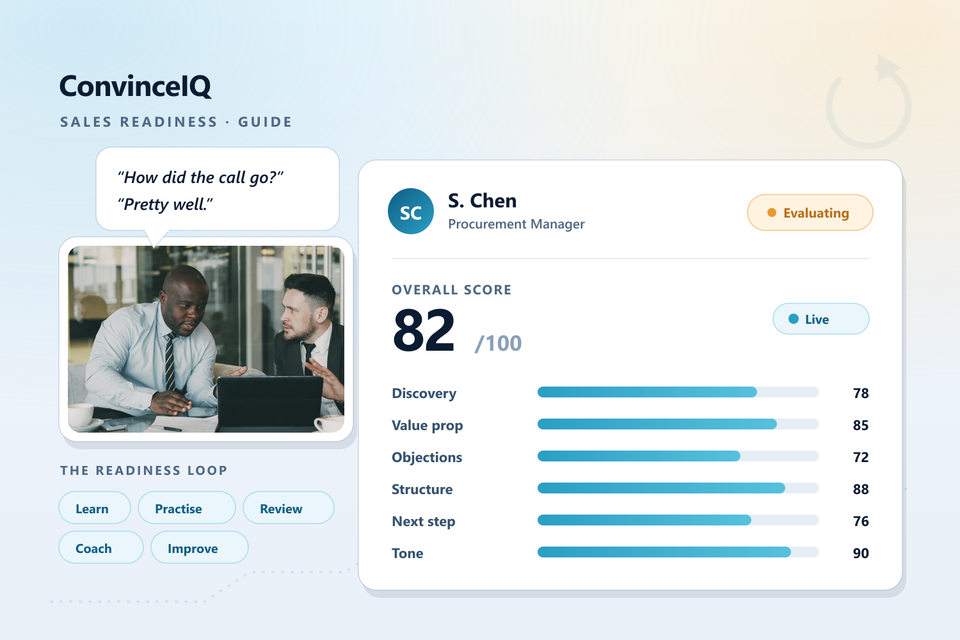
The teams that improve fastest replace one-off training events with a continuous cycle we call the readiness loop: learn, practise, review, coach, improve.
- Learn. Short, focused input on one skill or scenario — not a day of slides.
- Practise. Reps rehearse realistic conversations before facing real customers: discovery calls, objection handling, renewal conversations. AI roleplay has made this practical on demand, without waiting for a manager's calendar.
- Review. The practice conversation gets scored against clear criteria, with specific feedback on what to change.
- Coach. Manager and rep go through that feedback together and agree on what to work on.
- Improve. The rep runs the scenario again — and the loop repeats.
The point of the readiness loop is that weaknesses show up in practice sessions instead of in live deals.
Make coaching specific
"How did the call go?" "Pretty well." That exchange is where coaching starts in most teams — and where it ends. Without a record of the conversation, a manager has nothing to work with but the rep's own impression.
Scored practice conversations change that. Now the manager can point at something: the rep stopped asking discovery questions after two minutes. The pitch came before the customer's problem was clear. The discount appeared at the first objection. When every rep is assessed against the same criteria — discovery quality, value positioning, objection handling, product knowledge — a coaching session starts with "here's what to work on" instead of "how do you think it went?"
What the readiness loop looks like in practice
One Microsoft partner we work with — a ten-person team selling across Microsoft 365, Dynamics 365 and Copilot — replaced its train-and-release onboarding with the readiness loop. New reps now practise realistic buyer conversations before their first customer meetings, managers coach from scored sessions rather than impressions, and the team runs a quarterly training rhythm that ends in an assessed roleplay. Six months in, the biggest change isn't a headline metric. It's that every coaching conversation starts from evidence.
Where to start
You don't need to rebuild your whole enablement programme to test the readiness loop:
- Pick the one scenario your team handles worst — discounting, discovery, renewals — and make it the first practice scenario.
- Define four to six observable scoring criteria, so "good" means the same thing for every rep.
- Make practice a standing rhythm. Thirty minutes a week beats a quarterly training day.
- Review feedback with reps one-to-one — that's where behaviour actually changes.
Most teams already have enough sales content. What they lack is enough sales practice. Closing that gap is where better performance comes from.
About ConvinceIQ
ConvinceIQ is an AI sales roleplay and coaching platform for revenue teams. Reps practise realistic buyer conversations — discovery, objection handling, value positioning — and managers review scores and feedback to see who is ready and where to coach next.
Frequently asked questions
What is sales readiness?
Sales readiness is the ability of a salesperson to perform in a real customer conversation — asking strong discovery questions, positioning value, handling objections and knowing when to involve a specialist. It differs from product knowledge, which is only the material a rep can recall.
Why doesn't sales training improve performance on its own?
Because training transfers information but doesn't build skill. Reps can complete every session and still perform inconsistently in live conversations. Performance improves when training is paired with repeated practice, scoring and coaching.
How often should sales reps practise?
Weekly practice beats occasional intensive training. A standing rhythm of around thirty minutes per week keeps skills warm and lets weaknesses surface in practice rather than in deals.
Is AI roleplay effective for sales training?
Yes, as a practice layer. AI roleplay lets reps rehearse realistic buyer conversations on demand and get immediate scored feedback, without consuming manager time. It complements live coaching rather than replacing it — the manager's role shifts to reviewing feedback and coaching on evidence.
How do you measure whether a sales rep is ready?
Score practice conversations against fixed criteria — discovery quality, value positioning, objection handling and product knowledge — and track improvement over time. Consistent scores across scenarios are a far better readiness signal than training attendance.