Insurance is one of the hardest products to sell well. A new advisor has to earn trust quickly, explain complex protection and savings products in plain language, and handle emotionally charged conversations about money, family, and risk — often against a cheaper competitor or a client who would rather not think about it at all.
Most agency forces still train for this with licensing prep, product decks, and occasional roleplay with a manager. Those matter, but they are hard to scale across thousands of agents and impossible to repeat on demand. The result is long ramp times, inconsistent messaging, and a large share of new advisors leaving before they ever become productive.
ConvinceIQ is an AI sales roleplay and coaching platform built to close that gap. This playbook walks through how insurance agency training teams use it to ramp advisors faster and coach the conversations that actually decide whether a policy gets signed.
Why insurance sales is hard to train for
A few things make insurance uniquely demanding to train for:
- Continuous, high-volume onboarding. Large agency forces bring in new advisors in weekly cohorts, all year round. There is never a quiet period to train them properly.
- High early attrition. A large share of new advisors leaves within the first year, often before becoming productive — so every week of slow ramp time is recruiting and licensing spend that never pays back.
- Complex, regulated products. Advisors must master intricate product mechanics — health schemes, deferred annuities, participating life policies, pension schemes — and explain them accurately and within the bounds of approved messaging.
- Skeptical, risk-averse clients. Prospects compare premiums, distrust commission motives, and postpone decisions. Winning them over is a conversation skill, not a product-knowledge skill.
- A distributed, commissioned force. Agency leaders cannot sit in on every client meeting, yet they are accountable for what thousands of advisors say in the field.
Live client meetings are the worst place to practise these skills for the first time. Advisors need a safe, repeatable environment to build them before they sit across from a real prospect.
The two-department reality of insurance training
It helps to be precise about who this playbook is for. Major insurers typically run two completely separate training functions. The corporate L&D department, under HR, onboards salaried head-office staff — actuaries, underwriters, claims assessors. The agency training department, often called the sales academy, answers to the Chief Agency Officer or Head of Distribution and processes the constant flow of new agents and financial advisors.
Inside that academy, licensing and compliance teams guide recruits through regulatory requirements such as Hong Kong's Insurance Intermediaries Qualifying Examination (IIQE), product specialists teach the policy suite, and sales coaches run client-interaction practice. ConvinceIQ is built for that third group — the sales coaching layer — and for the academy leaders who need it to work at cohort scale.
Practise against clients who push back like real prospects
With ConvinceIQ, advisors run live voice roleplays with AI buyers that behave like the people they actually sell to. Using Buyer Personas, an enablement team can save reusable profiles — a price-shopping parent comparing premiums, a rushed professional who keeps postponing, a skeptical client who has been mis-sold to before — each with its own role, mood, language, and family or business context.
In session setup, the advisor chooses the persona, the scenario, the language, and a timebox for the call. The AI client then raises realistic concerns, objections, and buying signals, and the context stays locked so the scenario does not drift mid-call.
Ground every call in your products and approved messaging
A roleplay is only as useful as the product knowledge behind it. Product Profiles let you standardise each policy's value proposition, proof points, differentiators, and the objections advisors hear most — and you can upload product documents to enrich them. That same profile grounds both the AI client and the scoring, so practice reflects your real portfolio rather than a generic script. When a product launches or a policy changes, you update one profile and every advisor in the force practises the new story — no roadshow, no reprinted decks.
Product Profiles also carry disallowed claims, so practice stays inside the boundaries of your approved messaging. Combined with the transcript and scorecard every session produces, that gives the academy a reviewable record of how advisors learn to talk about products — without ConvinceIQ acting as a compliance system.
Company Profiles add the seller-side context — your firm, your positioning, your advisory model — so the AI client responds to the story your advisors are actually supposed to tell.
Score the skills that decide insurance conversations
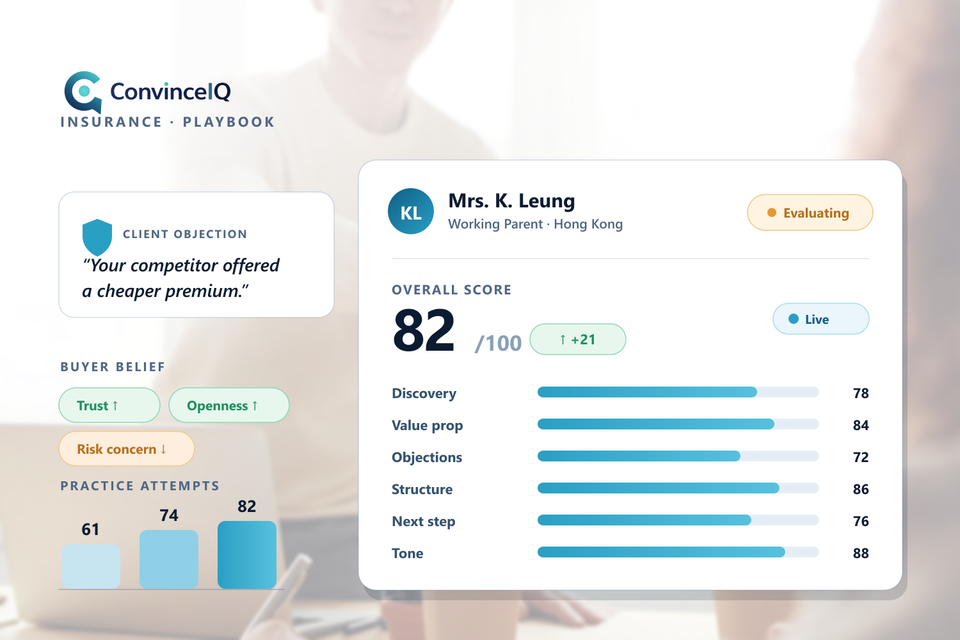
Every practice call produces a transcript and a scorecard. ConvinceIQ scores an overall result plus six dimensions:
- Discovery — did the advisor uncover the client's situation, dependants, and real financial needs?
- Value proposition — was the protection story explained clearly and in terms that matter to this client?
- Objections — were price, trust, and postponement concerns handled with confidence?
- Structure — did the conversation follow a logical path from needs to recommendation?
- Next step — did the advisor secure a concrete follow-up, referral, or application?
- Tone — was the delivery trustworthy and appropriate for a personal financial conversation?
Scores refresh during the call and run once more after it ends, and each session returns top strengths, top improvements, and suggested next practice goals, so an advisor always knows what to work on next.
See whether the client is actually convinced
Insurance clients are polite. A pleasant conversation can still end in "let me think about it". ConvinceIQ's buyer-belief signal tracks how the AI client's stance shifts through the call — trust, openness, fit belief, urgency, and risk concern — so advisors learn to tell the difference between a prospect who is genuinely warming up and one who is quietly disengaging. For a sale where perceived risk and trust decide everything, that signal is the one to watch.
The four conversations every advisor should practise
Almost every difficult insurance conversation is a variation of four situations. Build personas and scenarios for each, and most of the field's coaching needs are covered:
- The price objection — "your competitor is cheaper". Advisors practise moving from price to value instead of discounting or going defensive.
- The cancellation request — a client wants to surrender a policy. Advisors practise uncovering the real concern behind the request before offering retention options.
- The jargon barrier — complex coverage explained so a client actually understands it. Advisors test analogies in a safe environment until the explanation lands.
- The empathetic cross-sell — spotting a genuine gap in a client's portfolio without sounding like quota-chasing.
Turn onboarding into a repeatable programme
Practice works best inside a structured programme. With learning modules, you can build self-paced chapters from PDFs, slide decks, video, and web pages — product training, market background, messaging guidance — with per-chapter progress tracking. Training plans then bundle those modules and roleplay scenarios into an assignable path for an individual or a whole weekly cohort, with completion tracking so nothing gets skipped.
A new advisor can move from learning the product, to practising the objection, to being scored on it, all in one place — and the academy can run the same programme for every cohort without adding trainers.
Review what advisors actually said
Because every session leaves a transcript, a scorecard, and the buyer-belief detail, managers coach from what was actually said rather than a general impression. Call History keeps ended sessions available for review, and Team Insights give agency leaders grouped views by advisor, recent activity, and score signals, so it is clear who has adopted the programme and where follow-up is needed. For the academy head, that doubles as evidence for the executive team: adoption, completion, and score movement by cohort, rather than anecdotes. Enterprise teams can also upload recordings of real client calls for scoring and define custom scorecards that match their own advisory model.
Built for multilingual advisor teams
Asian agency forces sell in the language of the client — Cantonese, Mandarin, Malay, English, and more, often mixed within the same conversation. ConvinceIQ supports practice in 19 languages, with live English translation so a manager can still review and coach a session that happened in another language. A regional organisation can hold every market to the same standard without needing a coach fluent in each language.
How to get started
A simple way to roll this out for an agency force:
- Build Product Profiles for your core policies, including the objections advisors hear most and the claims they must not make.
- Create Buyer Personas that mirror your real client segments — young families, pre-retirees, business owners — in the languages they speak.
- Assign a training plan that pairs product learning with objection-handling roleplays for each new cohort.
- Have sales coaches review the first weeks of sessions in Call History and coach from the scorecards.
- Use Team Insights to track adoption across districts and double down on the scenarios that move scores.
ConvinceIQ helps insurance agency forces turn occasional training into continuous, measurable practice, so advisors ramp faster and every client conversation is a little sharper than the last. To see it in action, visit ConvinceIQ.com.