Medical sales is one of the hardest sales jobs to train for. A new device or pharmaceutical rep has to earn credibility with clinicians who have spent years mastering their field, navigate procurement committees and gatekeepers, and explain clinical and economic value under real scrutiny — often while a competitor is meeting the same account.
Most teams still train for this with product decks, ride-alongs, and the occasional roleplay with a manager. Those matter, but they are hard to scale and impossible to repeat on demand. The result is long ramp times and inconsistent messaging across a field team.
ConvinceIQ is an AI sales roleplay and coaching platform built to close that gap. This playbook walks through how medical device and pharma enablement teams use it to ramp reps faster and coach the conversations that actually decide deals.
Why medical sales is hard to train for
A few things make clinical selling especially demanding to prepare reps for:
- Long ramp times. Industry research has long pointed to ramp periods of seven months or more before a new seller is fully productive, and clinical products only add to that curve.
- High-stakes, knowledgeable buyers. Surgeons, physicians, pharmacists, and procurement leads ask detailed questions and are trained to be skeptical.
- Complex objections. Efficacy, safety, cost, reimbursement, switching risk, and formulary access all come up, often in the same conversation.
- Consistency across the field. A large regional team needs every rep to represent the same approved value story, not their own version of it.
Live customer calls are the worst place to practise these skills for the first time. Reps need a safe, repeatable environment to build them before they are in front of a real clinician.
Practise against buyers who push back like real clinicians
With ConvinceIQ, reps run live voice roleplays with AI buyers that behave like the people they actually sell to. Using Buyer Personas, an enablement team can save reusable profiles — a guarded surgeon, an evaluating hospital pharmacist, a cost-focused procurement lead — each with its own role, seniority, mood, language, and company context.
In the session setup, the rep chooses the persona, the scenario (discovery, pitch, or objection handling), the language, and a timebox for the call. The AI buyer then challenges them with realistic questions, concerns, and buying signals, and the context stays locked so the scenario does not drift mid-call.
Ground every call in your product, evidence, and objections
A roleplay is only as useful as the product knowledge behind it. Product Profiles let you standardise the value proposition, proof points, differentiators, and the common objections for each device or therapy, and you can upload source material to enrich them. That same profile grounds both the AI buyer and the scoring, so practice reflects your real portfolio rather than a generic script.
Company Profiles add account context — the type of hospital system, its priorities, or a specific network — so a rep can rehearse for the account in front of them.
Score the skills that decide medical deals
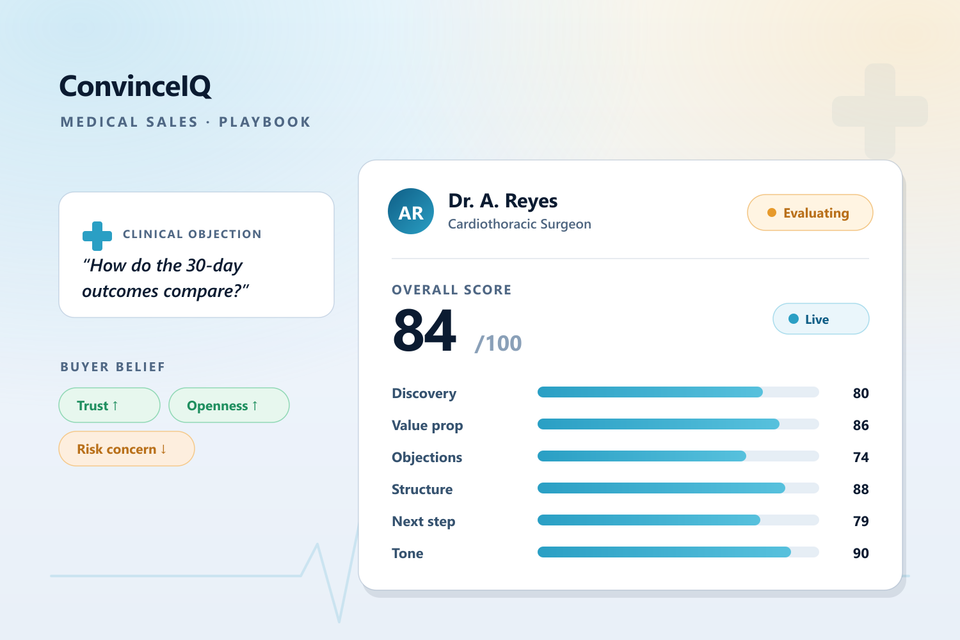
Every practice call produces a transcript and a scorecard. ConvinceIQ scores an overall result plus six dimensions:
- Discovery — did the rep uncover the clinical and economic need?
- Value proposition — was the value explained clearly and credibly?
- Objections — were efficacy, cost, and risk concerns handled with confidence?
- Structure — did the conversation follow a logical path?
- Next step — did the rep secure a concrete next action?
- Tone — was the delivery professional and appropriate for a clinical buyer?
Scores refresh during the call and run once more after it ends, and each session returns top strengths, top improvements, and suggested next practice goals, so a rep always knows what to work on next.
See whether the buyer is actually convinced
Medical buyers are risk-averse, and a polite conversation can still end in no decision. ConvinceIQ's buyer-belief signal tracks how the AI buyer's stance shifts through the call — trust, openness, fit belief, urgency, and risk concern — so reps can tell the difference between a buyer who is genuinely warming up and one who is quietly disengaging. For clinical selling, where perceived risk is often the real blocker, that signal is especially useful.
Turn onboarding into a repeatable program
Practice works best inside a structured program. With learning modules, you can build self-paced chapters from PDFs, slide decks, video, and web pages — product training, clinical background, messaging guidance — with per-chapter progress tracking. Training plans then bundle those modules and roleplay scenarios into an assignable path for an individual or a whole cohort of new hires, with completion tracking so nothing gets skipped.
A new rep can move from learning the product, to practising the objection, to being scored on it, all in one place.
Coach with evidence, not impressions
Because every session leaves a transcript, a scorecard, and the buyer-belief detail, managers coach from what was actually said rather than a general impression. Call History keeps ended sessions available for review, and Team Insights give managers grouped views by rep, recent activity, and score signals, so it is clear who has adopted the program and where follow-up is needed. Enterprise teams can also bring in existing call recordings and define custom scorecards.
Built for regional and multilingual medical teams
Medical device and pharma teams often sell across markets. ConvinceIQ supports practice in many languages, with live English translation so a manager can still review and coach a session that happened in another language. A regional team can hold every market to the same standard without needing a coach fluent in each one.
How to get started
A simple way to roll this out for a medical sales team:
- Build Product Profiles for your key devices or therapies, including the objections reps hear most.
- Create a few Buyer Personas that mirror your real buying committee — clinician, pharmacist, procurement.
- Assign a training plan that pairs product learning with objection-handling roleplays for new hires.
- Have managers review the first weeks of sessions in Call History and coach from the scorecards.
- Use Team Insights to track adoption and double down on the scenarios that move scores.
ConvinceIQ helps medical sales teams turn occasional training into continuous, measurable practice, so reps ramp faster and every conversation with a clinician is a little sharper than the last. To see it in action, visit ConvinceIQ.com.