In most of Asia, insurance is not sold in one language. A Hong Kong advisor pitches in Cantonese, drops into English for the product terms, and follows up in Mandarin. A Malaysian advisor moves between Bahasa Malaysia and English depending on who is in the room. Singapore, Taiwan, the Philippines, Indonesia — every market has its own version of the same reality: the language of the client decides the sale, and it is rarely just English.
This creates a quiet problem for enablement teams. The sales training material is in English. The coaching frameworks are in English. And almost every AI sales roleplay tool on the market is English-first, treating other languages as a settings toggle at best. So advisors practise in one language and perform in another.
Why practising in English is not enough
Sales is a language skill before it is a product skill. The moment that decides a deal — the hesitant question about a parent's health, the joke that breaks the tension, the analogy that finally makes a policy rider make sense — happens in the client's own words. An advisor who can handle a price objection fluently in English has not automatically learned to handle it in Cantonese. The vocabulary is different, the politeness conventions are different, and the trust signals are different.
If practice only happens in English, the first time an advisor discovers whether their Mandarin explanation of a deferred annuity actually works is in front of a real client. That is the wrong place to find out.
The code-switching problem
There is a second, subtler issue: real client conversations in Asia are often not in one language at all. Hong Kong advisors mix English financial terms into Cantonese sentences — "premium", "rider", "surrender value" — because that is how clients actually talk about money. Malaysian advisors code-switch between Bahasa Malaysia and English in the same paragraph.
Many speech tools assume one clean language per conversation. Train on a platform that forces a single language, and advisors end up practising a conversation that does not exist — pure, formal, single-language dialogue that no real client speaks.
What multilingual AI practice looks like
ConvinceIQ was built for this reality rather than adapted to it:
- Practice in 19 languages. Advisors run live voice roleplays in the language of their market — Cantonese, Mandarin, Malay, English, and more — against AI clients that respond naturally in the same language.
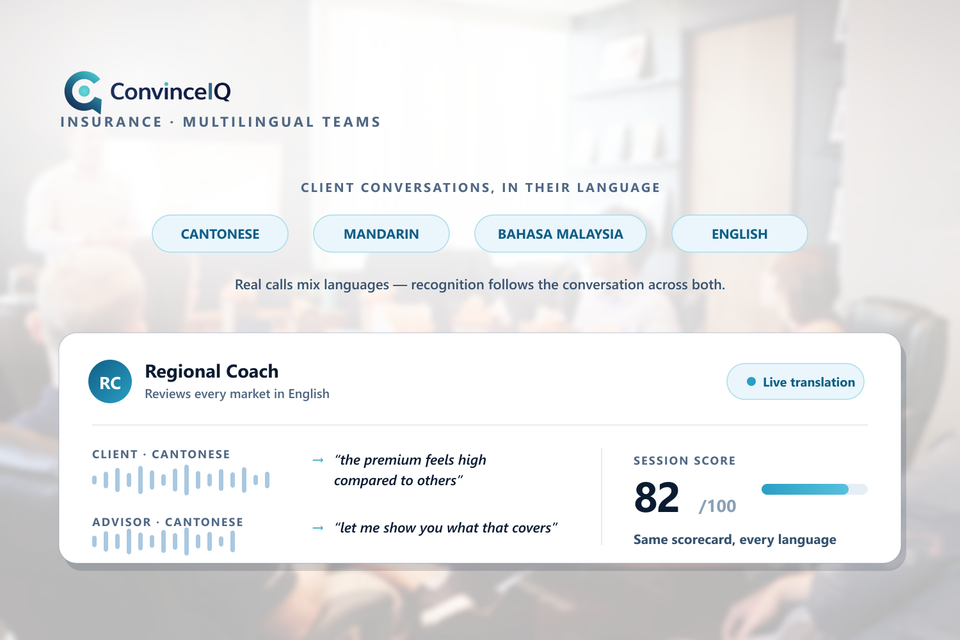
- Recognition that handles code-switching. In markets where advisors genuinely mix languages, such as Hong Kong and Malaysia, ConvinceIQ's transcription is built to follow the conversation across both, so practice reflects how clients really speak rather than an artificial single-language script.
- Buyer Personas per market. Enablement teams save personas with the client's language, role, mood, and context — a Cantonese-speaking parent comparing premiums is a different practice scenario from a Mandarin-speaking business owner, and both can be built once and reused by every cohort.
- Live English translation for coaches. A regional enablement lead does not need to speak five languages to coach five markets. Every session transcript can be reviewed with live English translation, so one coaching standard applies across the whole region.
- One scorecard everywhere. The same six dimensions — discovery, value proposition, objections, structure, next step, tone — score a Cantonese session the same way they score an English one, so advisors in every market are held to the same bar.
What this means for regional rollouts
For a regional agency force, multilingual practice changes the economics of coaching. Instead of recruiting bilingual coaches for every market, or accepting that non-English markets get a thinner version of the training programme, the enablement team builds one programme — personas, scenarios, scorecards, training plans — and every market runs it in its own language. Team Insights then shows adoption and scores across markets on the same scale, so a regional leader can see which districts are actually practising.
A practical starting point:
- Identify the two or three languages your advisors genuinely sell in — including how they mix them.
- Build your core Buyer Personas in each of those languages, not just in English.
- Assign the same scenario-based training plan to every market, so scores are comparable.
- Have coaches review translated transcripts in Call History, and focus their time on the advisors whose scores lag in any language.
Your clients choose the language of the conversation. Your advisors should be able to practise in it.
To see how ConvinceIQ supports multilingual insurance teams, get in touch.