Gartner for Sales has published its list of the five AI use cases that are improving sales productivity now: account and buyer intelligence, lead management, deal orchestration, manager coaching, and pipeline and forecast management. It is a short, useful document, and if you run a sales team it is worth twenty minutes.
This article is about the one use case of the five that depends on something most teams do not yet collect, and why that makes it the one with the biggest upside: coaching.
The five use cases in one paragraph
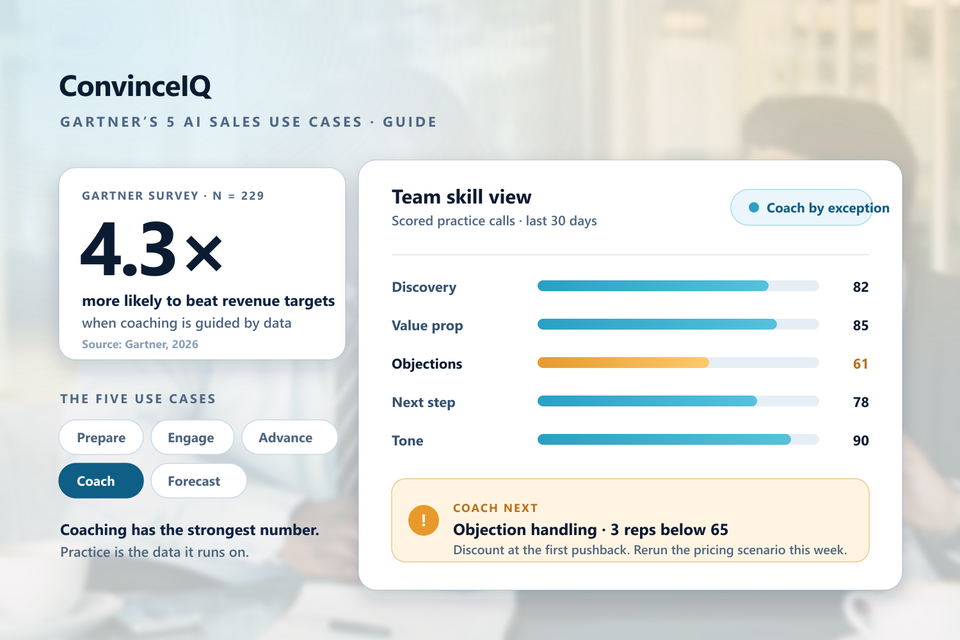
Gartner organises the five along the sales motion: prepare, engage, advance, coach, forecast. Account and buyer intelligence turns first- and third-party data into next best actions for sellers. Lead management uses AI agents, voice and email to qualify inbound prospects and book meetings without human latency. Deal orchestration reads deal signals, flags risk and guides execution. Manager coaching is an AI feedback loop that identifies skill gaps and win-rate blockers and guides managers with data-driven coaching advice. Pipeline and forecast management brings deal scoring and risk flags into the management rhythm.
For each one Gartner gives a Do and a Don't, a survey finding from its own research, and a set of outcome figures compiled from what vendors have published about their customers. Gartner is careful to say it has not verified the vendor figures. We will be equally careful below.
Coaching has the strongest number
Each use case comes with a multiple from Gartner's surveys of sales leaders. Account intelligence: organisations that provide AI-enabled next best actions are 2.6 times more likely to report commercial growth. Deal orchestration: improving where sellers spend their time makes exceeding revenue targets 3.3 times more likely. Lead management: marketing and sales collaborating on messaging makes high conversion 3.3 times more likely.
Coaching tops them all. In Gartner's words: organisations using data-driven guidance to identify the highest-impact coaching opportunities are 4.3 times more likely to exceed their revenue growth targets. That is from 229 CSOs and sales executives, and it is the largest multiple in the document.
It is also the least surprising if you have ever managed sellers. A manager with eight reps and a full calendar coaches whoever is loudest, or whoever lost the most recent deal. Data-driven guidance replaces that with a view of which rep, on which skill, in which stage of the conversation, is leaving the most revenue on the table. The multiple is large because the alternative is so close to random.
What the vendors claim, and how to read it
Gartner's outcome bullets for coaching are striking: a 55% reduction in seller onboarding ramp time, a 21% improvement in seller performance, a 14% improvement in opportunity progression and a 25% increase in lead-to-opportunity conversion. These are customer results compiled by Gartner from vendor publications, not Gartner's own measurements, and Gartner says so on the slide.
Read them as the ceiling the category is claiming rather than as a forecast for your team. What they do tell you is where AI coaching tends to show up first: in ramp time, because new hires are the people with the most to learn and the least history to coach from.
Gartner's Do and Don't for coaching
Two pieces of advice in the ebook are more useful than the numbers. The Do: put time into enabling AI with semantics, so generative AI can explain what the data is saying. A score is not coaching; the explanation of why the score is what it is, in language a rep can act on, is coaching. The Don't: do not go big without buy-in from the chief sales officer to hold frontline managers accountable for coaching. The tool surfaces the opportunity; someone still has to have the conversation.
The input problem
Here is the catch with the coaching use case. Data-driven guidance needs data about how each rep actually sells, and most teams only have that for live deals, after the conversation has already cost something. Call recording and conversation intelligence help, but they coach on the deal you just lost.
The teams that make Gartner's coaching loop work have a second source of conversation data: practice. A rep rehearses a discovery call, an objection or a renewal conversation against a realistic buyer, the session is scored against the same criteria as everyone else's, and the manager sees the skill gap before a customer does. That is what AI sales roleplay is for. It turns the coaching use case from a post-mortem into a pre-flight check.
- Practise. Reps run realistic buyer conversations on demand, without waiting for a manager's calendar.
- Score. Every session is scored overall and skill by skill, with strengths, gaps and next steps written for the rep.
- Guide. Managers see the team by skill and step in where the data says it matters, which is Gartner's data-driven guidance in practice.
- Repeat. The rep runs the scenario again, and the next score shows whether the coaching landed.
What to take from the ebook
If you are deciding where to put an AI budget in sales this year, the document points to a sequence:
- Start with coaching, because it has the strongest evidence and the lowest dependency on CRM clean-up.
- Instrument the inputs, not only the outputs: scored conversations, practice and live, are the data the use case runs on.
- Get the CSO to make coaching a managerial accountability before buying anything.
- Treat vendor-reported outcomes as the ceiling, and measure your own ramp time and win rate from day one so you have a number of your own.
The full ebook, 5 AI Use Cases to Improve Sales Productivity and Performance, is available from Gartner for Sales at https://www.gartner.com/en/webinar/978489/1965518-5-ai-use-cases-delivering-measurable-sales-productivity-gains-and-performance.
About ConvinceIQ
ConvinceIQ is an AI sales roleplay and coaching platform for revenue teams. Reps practise realistic buyer conversations, every session is scored and explained, and managers coach from evidence rather than impressions. It is the practice data that makes coaching data-driven.
Frequently asked questions
What are Gartner's five AI use cases for sales?
Account and buyer intelligence, lead management and outreach, deal orchestration, manager coaching, and pipeline and forecast management. Gartner for Sales published them in 2026 as the five AI use cases improving sales productivity now, each with what it is, why it works and the outcomes vendors report.
Which AI use case has the strongest evidence behind it?
Sales coaching. In Gartner's survey of 229 CSOs and sales executives, organisations using data-driven guidance to identify the highest-impact coaching opportunities were 4.3 times more likely to exceed their revenue growth targets, the largest multiple of the five use cases.
Are the outcome figures in the Gartner ebook verified?
The survey findings are Gartner's own research. The outcome bullets, such as a 55% reduction in onboarding ramp time, are an aggregate of results vendors published about their customers; Gartner notes it has not verified those and that results vary. This article attributes each kind of figure accordingly.
What does data-driven coaching need from a sales team?
Observed conversations, scored against the same criteria for every rep, so a manager can see where to coach rather than guess. Call recordings supply that for live deals; practice conversations supply it before a rep is in front of a customer, when the lesson is still cheap.
How does AI sales roleplay fit Gartner's coaching use case?
Roleplay is the input. Each practice call is scored, strengths and gaps are written out, and managers see a skill-by-skill view of the team. That is the data-driven guidance Gartner describes, applied to the part of the sales cycle before a live deal is at stake.