Asia remains the most compelling growth opportunity for life and health insurance firms globally. But capturing it takes more than launching new products. Clients increasingly expect a trusted advisor, not a transaction — someone who can turn financial planning into a genuinely personal relationship. Insurers across the region are investing heavily in professional training and digital enablement to make that vision real.
The hard part is execution: how do you train thousands of advisors to handle complex, high-stakes human conversations consistently?
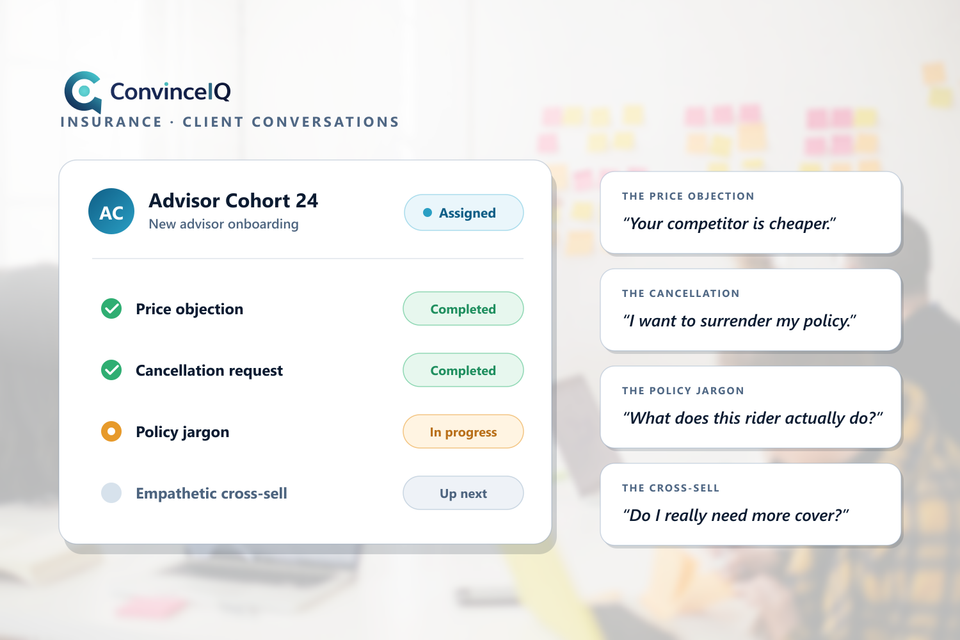
The answer is the same one every other high-stakes profession arrived at — practice in simulation before performance in public. Pilots do not learn in passenger flights, and advisors should not learn in front of real clients. Below are the four conversations that decide an insurance advisor's career, and how AI roleplay helps teams master them.
1. The price objection: "Your competitor is cheaper"
Every advisor hears it, usually within the first few meetings of their career. Untrained advisors react in one of two ways: they become defensive, or they reach for a discount they do not have. Both lose the deal — and the second loses the client's respect as well.
The skill is shifting the conversation smoothly from price to value: asking targeted questions that isolate exactly what the cheaper policy leaves out, then articulating the premium's benefits in terms that matter to this specific client — their family, their dependants, their actual exposure.
That is a conversation skill, and it only improves with repetition. With ConvinceIQ, advisors practise it against an AI client built as a price-shopping Buyer Persona, grounded in a Product Profile that carries the real differentiators and proof points of the policy being sold. After each call, the scorecard shows how well they handled the objection dimension — and they can run the scenario again immediately, trying a different line of questioning.
2. The policy cancellation request
A client asking to surrender a policy does not have to mean a lost account. But the save depends on what happens in the next sixty seconds: an advisor who argues or panics confirms the decision, while an advisor who stays curious often uncovers the real concern — a cash-flow problem, a life change, a misunderstanding of what the policy does — and can offer a retention option that addresses it.
This is one of the hardest conversations to coach, because it is rare and emotionally charged. Managers cannot manufacture enough real cancellation calls to train on. AI roleplay can. Advisors practise the conversation repeatedly with a client persona in a frustrated or rushed mood, learning to dig past the stated request to the economic or personal concern underneath. The buyer-belief signal shows them, in hindsight, the exact moment the client's trust started to recover — or collapsed.
3. Cutting through policy jargon
Insurance policies, compliance clauses, and financial terms are genuinely confusing to most clients. Confusion breeds inaction: a client who does not understand the recommendation does not buy it, and does not come back.
De-jargonising is a learnable skill — translating riders, exclusions, and surrender values into everyday examples that land. But every advisor's analogies are different, and some of them simply do not work. A roleplay environment is where to find out which ones do. Advisors practise explaining the same coverage concept to an AI client who asks naive but realistic follow-up questions, testing different analogies in a safe setting until the explanation is clear, accurate, and inside approved messaging. Product Profiles carry the disallowed claims, so practice never drifts into promises the firm cannot keep.
4. Cross-selling with empathy, not pressure
There is a fine line between a helpful coverage suggestion and an aggressive sales tactic, and clients feel it instantly. Push too hard and you lose the relationship; never raise it and you leave a family under-protected.
Good cross-selling starts with discovery, not with a pitch: uncovering organic gaps in a client's portfolio — the new baby, the new mortgage, the aging parents — and framing the suggestion as proactive advice. In ConvinceIQ, advisors practise exactly that discovery motion, and the scorecard's discovery and tone dimensions show whether they found the gap and whether the conversation stayed advisory. The goal is a conversation the client would describe as "my advisor looks out for me", not "my advisor tried to sell me something".
Making practice a habit, not an event
These four conversations share a pattern: each is rare enough in real life that advisors face them unprepared, and important enough that the first attempt should not be on a real client. The fix is structured, repeated practice — which is where most enablement programmes break down, because manager-led roleplay does not scale across a large agency force.
The practical rollout looks like this:
- Build a Buyer Persona for each of the four conversations, with the moods your advisors actually meet — skeptical, rushed, frustrated.
- Ground each scenario in a Product Profile so the AI client responds to your real policies and objections.
- Bundle the scenarios into a training plan assigned to every new cohort, with completion tracking.
- Have coaches review scorecards in Call History and use Team Insights to see which advisors — and which conversations — need attention.
For the full picture of how insurance agency training teams run this end to end, see our insurance sales playbook.
The future of insurance distribution in Asia belongs to firms that treat communication mastery as a trainable skill. Give your advisors a place to practise, make mistakes, and learn before they stand in front of your clients — and they will perform when it counts.
To see how ConvinceIQ works for insurance teams, get in touch.